
Doka-Grade Structural Panels and Reuse on Site
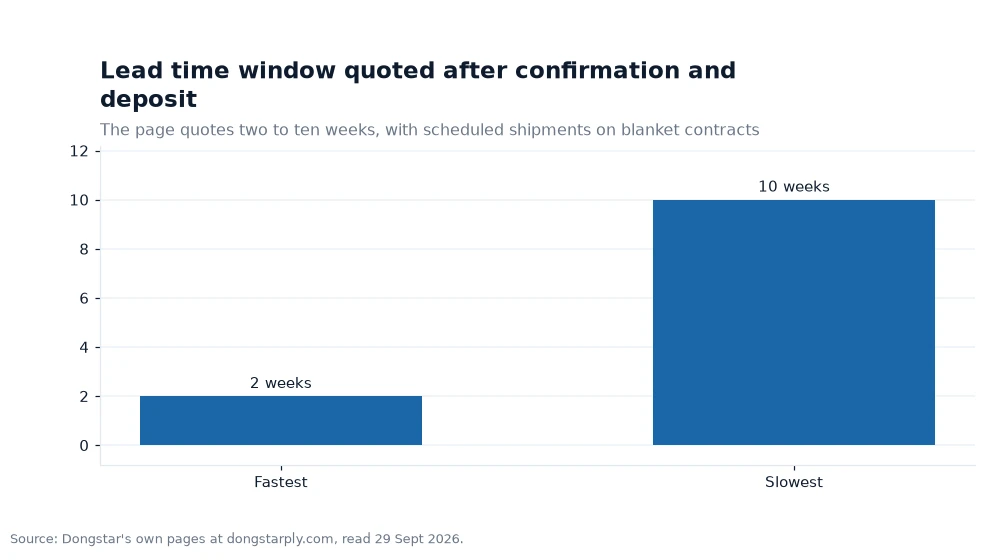
Reuse is where formwork economics are won or lost. The panel described as Doka-grade structural plywood is processed to survive repeated cycles, produces a smooth concrete face and reduces secondary plastering, while the page quotes two to ten weeks from confirmation and deposit. Those figures come from the manufacturer's own pages, read 29 Sept 2026.

Key takeaways
- The build is described as Doka-grade structural plywood, finished for repeated cycles of use; no cycle count is published.
- A cross-laminated veneer structure keeps the face flat under pressure, so joints stay tight between pours.
- Smooth concrete faces reduce secondary plastering and repair, shifting cost out of labour and into the panel.
- Lead time is two to ten weeks after confirmation and deposit, with scheduled shipments on blanket contracts.
Reading Doka-grade as a construction description
Doka-grade structural plywood is a description of construction and processing rather than a certificate, and it is worth reading it exactly that way. The page describes a panel built to a cross-laminated veneer structure and treated so that it survives repeated cycles of use, which puts the claim on build and treatment rather than on a test report. That is the whole of what the 3 Layer Plywood sheet specification says about reuse: build, processing, repeated cycles, and no fixed count attached to it.
That leaves the return on the claim in the hands of the site team. A panel built for many cycles can still be destroyed in three, through levered stripping, water left standing on a stack, or edges knocked against rebar during handling. The practical consequence is that a reuse specification should be written together with a stripping and storage procedure, so that the number in the tender is a target with a method behind it rather than an assumption.
Reuse economics: counting cycles rather than sheets
Panel price and panel cost are different numbers. Price is what a quotation says per square metre; cost is that figure divided by the number of pours the panel actually serves, plus the damage it leaves in the concrete. A panel at a higher price that serves twice as many cycles is the cheaper option on a project with a long pour programme, and the arithmetic is simple enough to run before the tender is submitted.
The variable that ruins the calculation is not the panel, it is the handling. Cycle counts on a real site vary across a set of panels in the same pour, because edges on the outer rows take more punishment than faces in the middle. Tracking life per set rather than per delivery gives a realistic average, and it gives a buyer evidence for the next order instead of an argument with the supplier.
Edges, stripping and the three ways panels die
Formwork panels tend to end in one of three ways: an edge that swells or splits after water gets into the core, a face that has been scored or levered during stripping, or a stack that was stored flat on the ground and warped before it was ever used. Only the first is a material question. The other two are procedure, and they are the reason sealing edges and raising stacks off the ground pay for themselves in a single season.
Stripping technique deserves a line in the method statement. Panels separated with a proper tool and lifted rather than levered keep their edges intact and their faces unmarked, which preserves both the flatness the concrete copies and the release behaviour of the surface. A crew briefed on that at the first pour usually keeps a set running far longer than one that learns it from a damaged delivery.
Smooth faces and the finishing cost they remove
The page connects the panel to the finish that follows: formwork built with it produces a smooth, even concrete face and significantly cuts the cost of secondary plastering and repair. That is worth quantifying at tender stage, because patching and rendering are labour-heavy and notoriously hard to estimate when the concrete surface is uneven.
Put a number on the alternative before comparing panel prices. If a rough face needs two operatives for three days per floor and a smooth face needs half that, the saving across ten floors dwarfs the difference between two panel quotations. The comparison only holds if both suppliers are asked to work to the same finish standard, so write the standard into the enquiry rather than leaving it to be discovered after the first pour.
Scheduling against a two-to-ten-week window
Lead time is quoted at two to ten weeks after order confirmation and deposit, with long-term contracts able to schedule shipments in advance rather than order by order. That spread is wide, and the sensible planning assumption is the slow end of it. A programme built on the fastest case has no room for a transport delay, a port congestion week or a re-inspection.
Order structure reduces the exposure. Contractors running repeating floors can place a blanket order and schedule releases, which keeps the material coming without repeating the whole purchasing cycle each time. The pages also note that packing is palletised and wrapped, trucked into containers at the port, plus that FOB, CIF and DDP terms are all available — as standard so the freight arrangement can be settled once for the project instead of negotiated pour by pour.
| Decision point | What the page states | What it changes on site |
|---|---|---|
| Panel build | Cross-laminated veneer structure; flat face under pressure | Joint tightness between pours and fewer packing shims |
| Grade description | Doka-grade structural plywood, processed for repeated cycles | Reuse planning, stripped and stored by procedure |
| Concrete finish | Smooth, even face with a significant fall in secondary plastering and repair | Lower finishing labour per floor, if the standard is written into the enquiry |
| Formaldehyde class | Release stated to meet or exceed E1; certificates on request | Supports interior and enclosed-space approvals |
| Lead time | Two to ten weeks after confirmation and deposit | Programme risk sits at the slow end of the window |
| Terms and packing | FOB, CIF or DDP; palletised, wrapped, trucked to port | Freight risk and container planning decided once, not per order |
Worked example: reuse against a ten-floor programme
Assume a formwork face of 480 m² per floor and a conservative four-pour life per set of panels. The first cycle needs 480 m² of panel; by the fourth pour the same set is covering the same area, so the material bought for four floors is still 480 m², not 480 × 4 = 1,920 m² (example arithmetic). Across a ten-floor programme that difference is where the money sits: 1,920 m² of single-use panel against roughly 1,200 m² of panel bought at a four-cycle assumption, with top-ups for damaged sets.
Cost per pour follows the same route. If a panel set costs the same as one cycle of a cheaper sheet but survives four pours, the effective material cost per pour is one quarter of the single-use figure, before any saving on plastering (example, using the assumed four-cycle life). The honest caveat is that the page does not publish a cycle count: it describes the panel as processed to withstand repeated use and leaves the number to site conditions. Plan with a conservative figure, log the real cycles per set, and the next tender gets a better number.
Frequently asked questions
How many times can this panel be reused?
The panel is described as Doka-grade structural plywood made for repeated cycles, without a published cycle count. Real life depends on stripping technique, edge protection and storage, so agree a count in the contract and log pours per set on site.
Does a smooth concrete face really reduce project cost?
The page states that it significantly reduces secondary plastering and repair, and that saving is labour rather than material. Compare it per floor rather than per sheet, and hold both quotations to the same finish standard so the numbers mean the same thing.
What lead time should a programme assume?
Shipment is quoted between two and ten weeks after the order is confirmed and the deposit is received. Build the programme around the slow end, and use a blanket contract with scheduled releases if the project runs repeating floors through a season.
Where reuse planning continues
Reuse figures only make sense against the rest of the formwork package, so read the formwork beam range, which carries its own published lead times and reuse notes, and then check the wider panel range for the surfaces used alongside it. A formwork system is bought as a set of parts, and each part has its own service life to plan for.
Panel build, finishing effects, formaldehyde class and the scheduling figures above are documented on the supplier's own pages — checked on 29 Sept 2026, as the basis for this as standard write-up[1].