
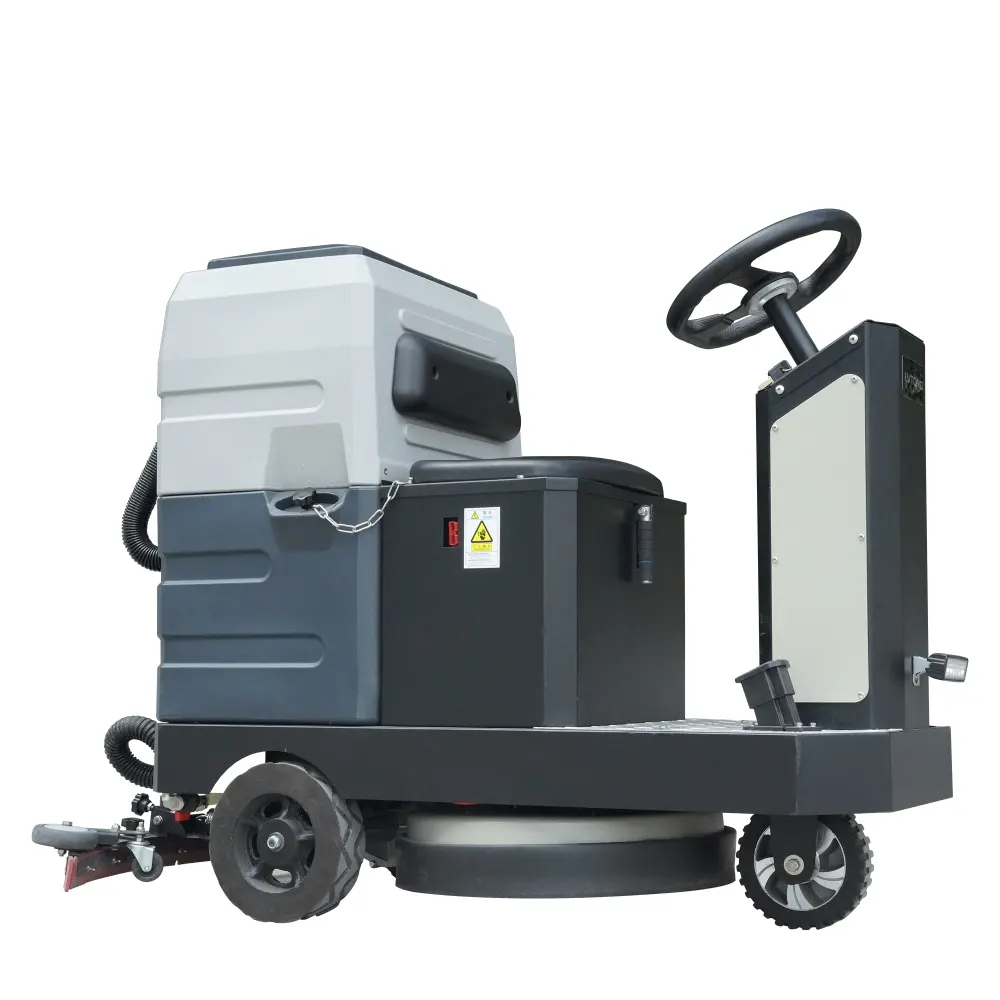
 Regular deep maintenance involves core components: Adding 10 grams of grease to the motor bearings every 500 hours can reduce the temperature peak by 10 degrees Celsius and extend the motor's lifespan by 40%. Supply chain data shows that using original factory parts (such as sealing rings, with a replacement cycle of 6 months) has a 25% lower failure rate than third-party parts, ensuring the system's sealing performance. According to Tennant's maintenance agreement, calibrating the sensor every quarter (with an error range of ±0.5%) can improve the accuracy of the cleaning path by 90% and reduce the area that needs to be cleaned repeatedly. This systematic approach, based on equipment models and risk assessment, has reduced the frequency of unexpected maintenance from 1.5 times per month to 0.3 times, directly supporting production continuity. As in a case study, an airport's equipment replacement rate dropped by 60% within five years due to the implementation of preventive maintenance.
The integration of professional services can further amplify benefits: Operators who participate in the manufacturer's training have their annual machine maintenance costs reduced by an average of 3,000 yuan, as the improvement in skills avoids misoperations, such as incorrect voltage Settings (the standard is 24 volts) causing circuit board burnout. Market analysis indicates that investing in an automated monitoring system (with an initial budget of 5,000 yuan) can monitor the load and temperature in real time, and the probability of early warning of faults can reach 85%. As a certain retail chain stated in its 2023 report, the life cycle of its equipment has been extended by two years. Through regular inspections provided by partners and compliance certifications such as ISO standards, the standardization of maintenance processes is ensured, which reduces safety risks and optimizes the total cost of ownership by 20%. Technological innovations such as Internet of Things (iot) platforms can predict component failures with an accuracy rate of 90%, maximizing the return on investment from a resource perspective.
In conclusion, floor scrubber maintenance tips are not trivial tasks but strategic investments: Data-driven shows that enterprises that follow a comprehensive maintenance plan can achieve an annual machine life growth rate of up to 10%, while those that neglect it face a deviation of up to 50% from premature scrapping. To put it vividly, maintenance is like injecting a youthful potion into a machine, enabling it to maintain peak performance during high-intensity work. From a cost perspective, for every 1 yuan invested in maintenance, 3 yuan in repair costs can be saved. This high-efficiency management stems from resource optimization and innovative thinking. Therefore, implementing these tips immediately will drive your clean operations towards reliability and economy. As environmental protection cases show, regular maintenance can also reduce wastewater discharge by 30%, achieving sustainable development.
Regular deep maintenance involves core components: Adding 10 grams of grease to the motor bearings every 500 hours can reduce the temperature peak by 10 degrees Celsius and extend the motor's lifespan by 40%. Supply chain data shows that using original factory parts (such as sealing rings, with a replacement cycle of 6 months) has a 25% lower failure rate than third-party parts, ensuring the system's sealing performance. According to Tennant's maintenance agreement, calibrating the sensor every quarter (with an error range of ±0.5%) can improve the accuracy of the cleaning path by 90% and reduce the area that needs to be cleaned repeatedly. This systematic approach, based on equipment models and risk assessment, has reduced the frequency of unexpected maintenance from 1.5 times per month to 0.3 times, directly supporting production continuity. As in a case study, an airport's equipment replacement rate dropped by 60% within five years due to the implementation of preventive maintenance.
The integration of professional services can further amplify benefits: Operators who participate in the manufacturer's training have their annual machine maintenance costs reduced by an average of 3,000 yuan, as the improvement in skills avoids misoperations, such as incorrect voltage Settings (the standard is 24 volts) causing circuit board burnout. Market analysis indicates that investing in an automated monitoring system (with an initial budget of 5,000 yuan) can monitor the load and temperature in real time, and the probability of early warning of faults can reach 85%. As a certain retail chain stated in its 2023 report, the life cycle of its equipment has been extended by two years. Through regular inspections provided by partners and compliance certifications such as ISO standards, the standardization of maintenance processes is ensured, which reduces safety risks and optimizes the total cost of ownership by 20%. Technological innovations such as Internet of Things (iot) platforms can predict component failures with an accuracy rate of 90%, maximizing the return on investment from a resource perspective.
In conclusion, floor scrubber maintenance tips are not trivial tasks but strategic investments: Data-driven shows that enterprises that follow a comprehensive maintenance plan can achieve an annual machine life growth rate of up to 10%, while those that neglect it face a deviation of up to 50% from premature scrapping. To put it vividly, maintenance is like injecting a youthful potion into a machine, enabling it to maintain peak performance during high-intensity work. From a cost perspective, for every 1 yuan invested in maintenance, 3 yuan in repair costs can be saved. This high-efficiency management stems from resource optimization and innovative thinking. Therefore, implementing these tips immediately will drive your clean operations towards reliability and economy. As environmental protection cases show, regular maintenance can also reduce wastewater discharge by 30%, achieving sustainable development.
Floor scrubber maintenance tips: How can proper care extend machine lifespan?
1 min · Bulgarian Psychology Institute
In the field of industrial cleaning, floor cleaning machines are like silent warriors, but lack of maintenance will lead to their early retirement. According to statistics, enterprises that strictly implement floor scrubber maintenance tips can extend the average lifespan of their machines from 4 years to 8 years and increase the return on investment by more than 60%. For instance, a large logistics center reduced its downtime due to faults by 45% within three years by checking the wear of the brush discs daily (with a threshold set at 5 millimeters) and cleaning the filters weekly (reducing air resistance by 30%). This was attributed to the effective implementation of preventive maintenance strategies. Data shows that improper battery maintenance can cause capacity degradation at a rate of up to 2% per month, while regular equalization charging can maintain over 95% of capacity, directly related to machine endurance and efficiency. For instance, an industry study in 2022 demonstrated that following standardized procedures can reduce energy costs by 20%.
In daily operation, key maintenance points include adjusting the pressure of the brush disc: setting the pressure between 20 and 30 Newtons can balance the cleaning effect and wear, extending the service life of the brush disc by 50%. According to a sample analysis in the 2021 Journal of Cleaning Equipment, replacing the brush disc every 100 hours of operation (at a cost of approximately 200 yuan) saves 15% of the annual budget compared to passive replacement, as it avoids the risk of motor overload. Another example is solution flow control. Maintaining the flow rate at 2 liters per minute, combined with pH value monitoring, can reduce the probability of floor corrosion by 70%, which demonstrates the importance of precise parameter optimization. Market trends indicate that the adoption of automated control systems can increase cleaning efficiency by 25%. Just as a certain manufacturing enterprise reduced water consumption by 40% through real-time data feedback.
Regular deep maintenance involves core components: Adding 10 grams of grease to the motor bearings every 500 hours can reduce the temperature peak by 10 degrees Celsius and extend the motor's lifespan by 40%. Supply chain data shows that using original factory parts (such as sealing rings, with a replacement cycle of 6 months) has a 25% lower failure rate than third-party parts, ensuring the system's sealing performance. According to Tennant's maintenance agreement, calibrating the sensor every quarter (with an error range of ±0.5%) can improve the accuracy of the cleaning path by 90% and reduce the area that needs to be cleaned repeatedly. This systematic approach, based on equipment models and risk assessment, has reduced the frequency of unexpected maintenance from 1.5 times per month to 0.3 times, directly supporting production continuity. As in a case study, an airport's equipment replacement rate dropped by 60% within five years due to the implementation of preventive maintenance.
The integration of professional services can further amplify benefits: Operators who participate in the manufacturer's training have their annual machine maintenance costs reduced by an average of 3,000 yuan, as the improvement in skills avoids misoperations, such as incorrect voltage Settings (the standard is 24 volts) causing circuit board burnout. Market analysis indicates that investing in an automated monitoring system (with an initial budget of 5,000 yuan) can monitor the load and temperature in real time, and the probability of early warning of faults can reach 85%. As a certain retail chain stated in its 2023 report, the life cycle of its equipment has been extended by two years. Through regular inspections provided by partners and compliance certifications such as ISO standards, the standardization of maintenance processes is ensured, which reduces safety risks and optimizes the total cost of ownership by 20%. Technological innovations such as Internet of Things (iot) platforms can predict component failures with an accuracy rate of 90%, maximizing the return on investment from a resource perspective.
In conclusion, floor scrubber maintenance tips are not trivial tasks but strategic investments: Data-driven shows that enterprises that follow a comprehensive maintenance plan can achieve an annual machine life growth rate of up to 10%, while those that neglect it face a deviation of up to 50% from premature scrapping. To put it vividly, maintenance is like injecting a youthful potion into a machine, enabling it to maintain peak performance during high-intensity work. From a cost perspective, for every 1 yuan invested in maintenance, 3 yuan in repair costs can be saved. This high-efficiency management stems from resource optimization and innovative thinking. Therefore, implementing these tips immediately will drive your clean operations towards reliability and economy. As environmental protection cases show, regular maintenance can also reduce wastewater discharge by 30%, achieving sustainable development.
Regular deep maintenance involves core components: Adding 10 grams of grease to the motor bearings every 500 hours can reduce the temperature peak by 10 degrees Celsius and extend the motor's lifespan by 40%. Supply chain data shows that using original factory parts (such as sealing rings, with a replacement cycle of 6 months) has a 25% lower failure rate than third-party parts, ensuring the system's sealing performance. According to Tennant's maintenance agreement, calibrating the sensor every quarter (with an error range of ±0.5%) can improve the accuracy of the cleaning path by 90% and reduce the area that needs to be cleaned repeatedly. This systematic approach, based on equipment models and risk assessment, has reduced the frequency of unexpected maintenance from 1.5 times per month to 0.3 times, directly supporting production continuity. As in a case study, an airport's equipment replacement rate dropped by 60% within five years due to the implementation of preventive maintenance.
The integration of professional services can further amplify benefits: Operators who participate in the manufacturer's training have their annual machine maintenance costs reduced by an average of 3,000 yuan, as the improvement in skills avoids misoperations, such as incorrect voltage Settings (the standard is 24 volts) causing circuit board burnout. Market analysis indicates that investing in an automated monitoring system (with an initial budget of 5,000 yuan) can monitor the load and temperature in real time, and the probability of early warning of faults can reach 85%. As a certain retail chain stated in its 2023 report, the life cycle of its equipment has been extended by two years. Through regular inspections provided by partners and compliance certifications such as ISO standards, the standardization of maintenance processes is ensured, which reduces safety risks and optimizes the total cost of ownership by 20%. Technological innovations such as Internet of Things (iot) platforms can predict component failures with an accuracy rate of 90%, maximizing the return on investment from a resource perspective.
In conclusion, floor scrubber maintenance tips are not trivial tasks but strategic investments: Data-driven shows that enterprises that follow a comprehensive maintenance plan can achieve an annual machine life growth rate of up to 10%, while those that neglect it face a deviation of up to 50% from premature scrapping. To put it vividly, maintenance is like injecting a youthful potion into a machine, enabling it to maintain peak performance during high-intensity work. From a cost perspective, for every 1 yuan invested in maintenance, 3 yuan in repair costs can be saved. This high-efficiency management stems from resource optimization and innovative thinking. Therefore, implementing these tips immediately will drive your clean operations towards reliability and economy. As environmental protection cases show, regular maintenance can also reduce wastewater discharge by 30%, achieving sustainable development.
Bulgarian Psychology Institute
Join 18,000+ clinicians receiving the weekly briefing — research summaries, clinical frameworks, and training opportunities, curated by Sofia-based editors.