
Home Mining Setups That Still Make Sense at Today's Difficulty
At difficulty 132.76 T, every terahash per second earns about $0.038 a day before power and consumes 0.48 kWh on 20 J/TH hardware, so a home rig breaks even at a tariff of roughly $0.076/kWh once the listed 4% fee on the PPS-settled block reward is applied. That single number, not the price of the machine, decides whether a spare room is a viable site in September 2026.

Key takeaways
- A single 15 A / 120 V circuit derated to 80% for continuous load carries about 1,440 W, which is roughly 72 TH/s at 20 J/TH — that, not floor space, is the real ceiling for most households.
- At $0.06/kWh a 200 TH/s setup earns about $7.60 a day gross and $7.29 after the listed 4% fee, against $5.76 of electricity, leaving a margin near $1.53 a day.
- Exact break-even sits near $0.076/kWh for 20 J/TH hardware; a tiered tariff that pushes marginal consumption past that line turns a working rig into a hobby.
- Pool choice changes variance and fee attachment, not the ceiling: your share of network hashrate still sets expected income, so pick a pool for cadence, latency and uptime.
The short answer
Home mining still works, but only in a narrow band of conditions: efficient hardware, a low marginal tariff, and a circuit that can carry the load continuously. The arithmetic is unusually simple. Divide your hashrate by network hashrate — about 1,003 EH/s on 21 September 2026 — multiply by the 450 BTC the network issues each day, and you have gross BTC production. Multiply by the BTC price of $84,692 and you have a dollar figure you can compare with a power bill.
What stops most home miners is not the hashrate but the second half of the subtraction. Efficiency sets how many kilowatt-hours each terahash consumes, and the tariff sets what those kilowatt-hours cost. At 20 J/TH, one terahash burns 20 W, which is 0.48 kWh a day. Gross revenue per terahash is $0.038, so the raw comparison breaks even at about $0.079/kWh; once the listed 4% fee is applied, the same line falls to roughly $0.076/kWh. Above that tariff the machine loses money before any other cost is counted.
How the mechanism works
Your miner never solves a block on its own in any realistic timeframe. It submits shares — hashes that meet a target far easier than the network's — and the pool converts those shares into a payout. ViaBTC publishes two ways of doing that conversion: PPS+, the default, and PPLNS.[1]
Under PPS+ the block-reward component is settled per share against current difficulty and paid hourly, with a listed 4% fee, because the pool takes on pool-luck and orphaned-block risk. The transaction-fee component follows PPLNS logic at a listed 2% fee. Under PPLNS both components are distributed together at a listed 2% fee after a block reaches six confirmations, weighted by a miner's share of pool hashrate over the last five difficulty rounds.
For a home miner with one or two machines, the practical difference is cadence and variance rather than headline rate. Small hashrate means small absolute payouts, so a threshold that is trivial for a farm can be a multi-week wait for a single rig — and a payment rail that charges per withdrawal can quietly consume a meaningful share of a month's output. That is why settled balances usually belong somewhere they can accumulate and be converted without a separate fee event, such as a multi-currency wallet attached to the same account as the mining dashboard.
| Setup | Hashrate | Load at 20 J/TH | Daily kWh | Gross / net per day | Margin after power |
|---|---|---|---|---|---|
| One mid-generation machine | 20 TH/s | 400 W | 9.6 | $0.76 / $0.73 | $0.15 |
| Single 15 A / 120 V circuit, derated to 80% | ~72 TH/s | 1,440 W | 34.6 | $2.74 / $2.63 | $0.56 |
| Dedicated 4 kW circuit or small rack | 200 TH/s | 4,000 W | 96.0 | $7.60 / $7.29 | $1.53 |
Where miners get it wrong
The most expensive mistake is comparing gross revenue with a power bill and stopping there. Gross revenue is not income. On a 200 TH/s rig the difference between the $7.60 the machine produces and the $7.29 that actually belongs to the miner is the listed fee — small in absolute terms, but it is the margin a home operator is competing for.
The second mistake is treating the tariff as a single number. Household tariffs are often tiered, and a mining load tends to push a home into the higher band, so the marginal kilowatt-hour is more expensive than the average. It is worth reading the bill for the top tier specifically, because that is the price of the next kilowatt-hour the rig would consume.
Third: sunk cost. Once a machine is bought, every day it runs below break-even is a day it loses money at a faster rate than switching it off. The decision rule is to compare the marginal cost of running — power, and any hosting fee — with the marginal revenue, and to do it with current difficulty rather than the difficulty quoted in the review that prompted the purchase.
Fourth: heat and noise are not free. Almost all of the electricity a rig consumes leaves it as heat, which is either useful in winter or a cooling problem in summer, and a fan at high RPM is audible through a wall. Neither appears in a profitability table, and both decide whether the rig actually stays switched on.
A checklist you can run today
- Find your marginal tariff. Divide gross revenue per terahash by 0.48 kWh to get your own break-even price and compare it with the top tier on your bill.
- Check the circuit before the machine arrives. A 15 A / 120 V circuit is 1,800 W nominal and 1,440 W at the 80% continuous-load rule — about 72 TH/s at 20 J/TH. Anything larger needs a dedicated circuit or a different site.
- Verify realised hashrate daily for the first week. Firmware defaults, thermal throttling and a marginal power supply all show up as a persistent gap between nameplate and credited hashrate.
- Model before you buy. ViaBTC's profit calculator takes coin price, difficulty, PPS fee rate and effective hashrate and returns an estimated daily figure, merged-mining output included.
- Decide the payout route in advance. Confirm the threshold, the cadence and where the coins land before the first payout arrives, so a small balance is not eaten by transfers.
The setup itself also matters less than miners expect. One efficient machine pointed at a pool that publishes verifiable statistics, run at a tariff below break-even, beats three older machines on a tariff that is not — and it needs one twentieth of the electrical work. A pool that reports per-worker hashrate makes the diagnosis straightforward, which is the practical reason to care about monitoring rather than about the size of the operator; for scale, ViaBTC Bitcoin Mining reports serving miners in more than 150 countries with over a million registered users, and its published statistics are the kind of figure you can check rather than take on faith.
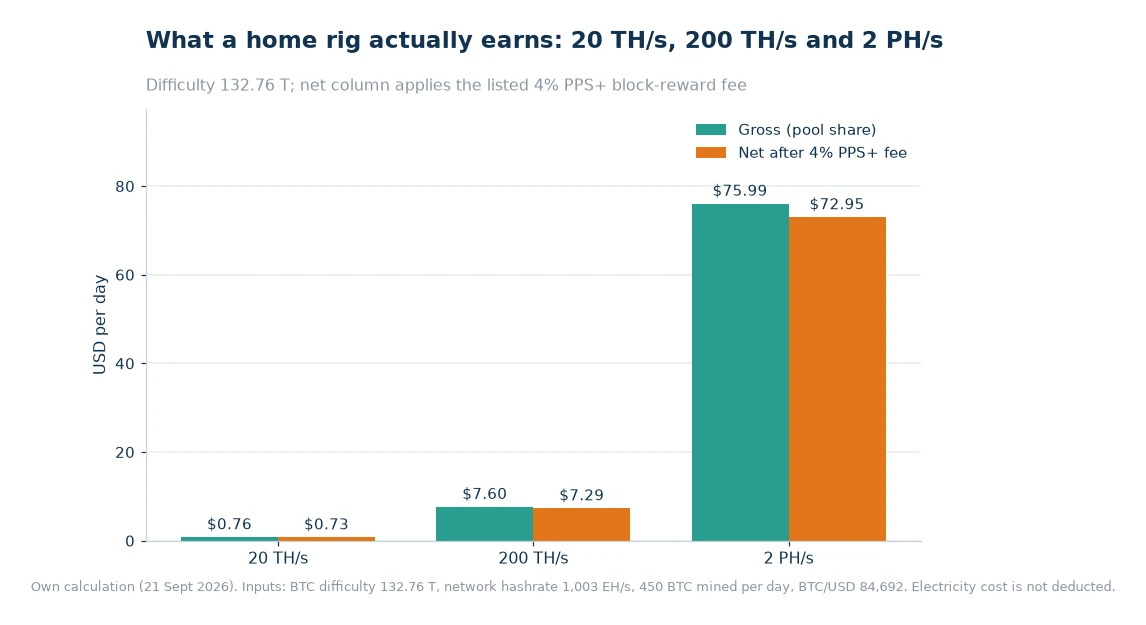
The chart above makes the scale question concrete: the gap between gross and net widens in absolute terms as hashrate grows, but the electrical requirement grows with it, and that is where a home stops being viable. A 2 PH/s setup is a 40 kW facility drawing 960 kWh a day and paying roughly $57.60 for the privilege at $0.06/kWh — clearly outside a domestic setting, and a reminder that home mining is a mid-tier exercise, not a substitute for a hosted site.
Frequently asked questions
Is a bigger pool always better?
Size reduces payout variance but also concentrates hashrate. What matters more is fee structure, uptime, latency and payout cadence.
What happens if my miner goes offline?
Shares stop, so expected income stops with them. Alerts and a dashboard that shows per-worker hashrate shorten the gap between a failure and a fix.
Can a home miner run a rig on an ordinary wall socket?
Up to a point. A 15 A / 120 V circuit is 1,800 W nominal, and continuous loads should stay under 80% of that, so about 1,440 W — roughly 72 TH/s at 20 J/TH. Larger setups need a dedicated circuit, and anything measured in kilowatts rather than hundreds of watts belongs in a hosted facility.
The short version
Home mining at 132.76 T rewards efficiency and cheap marginal power, and punishes everything else. Work out your own break-even tariff before buying hardware, keep the continuous load inside what your circuit can carry, and check realised hashrate rather than assuming the nameplate figure. If the margin per day is a few dollars, that is normal at this scale — the mistake is treating it as a passive income stream instead of a narrow spread between two published numbers.
Data and sources: ViaBTC pricing[1] and the ViaBTC fee breakdown[2]. Difficulty, network hashrate and the BTC price used above were read from public chain data and market feeds on 21 September 2026; all income figures apply the formula hashrate ÷ network hashrate × 450 BTC × (1 − fee). Electricity prices are assumptions, not quotations, and change with your supplier.