
A scent museum is not a tourist detour; it is a quality control classroom. The same sensory discipline a museum uses to present smells to thousands of visitors — controlled conditions, curated order, labelled references — is exactly the discipline a home fragrance line needs in its evaluation checkpoints. Brands that train their teams by nose, not by meeting, catch proportion and intensity problems months before a customer does. The checkpoints below translate museum practice into a practical QA routine for candles, diffusers and sprays.
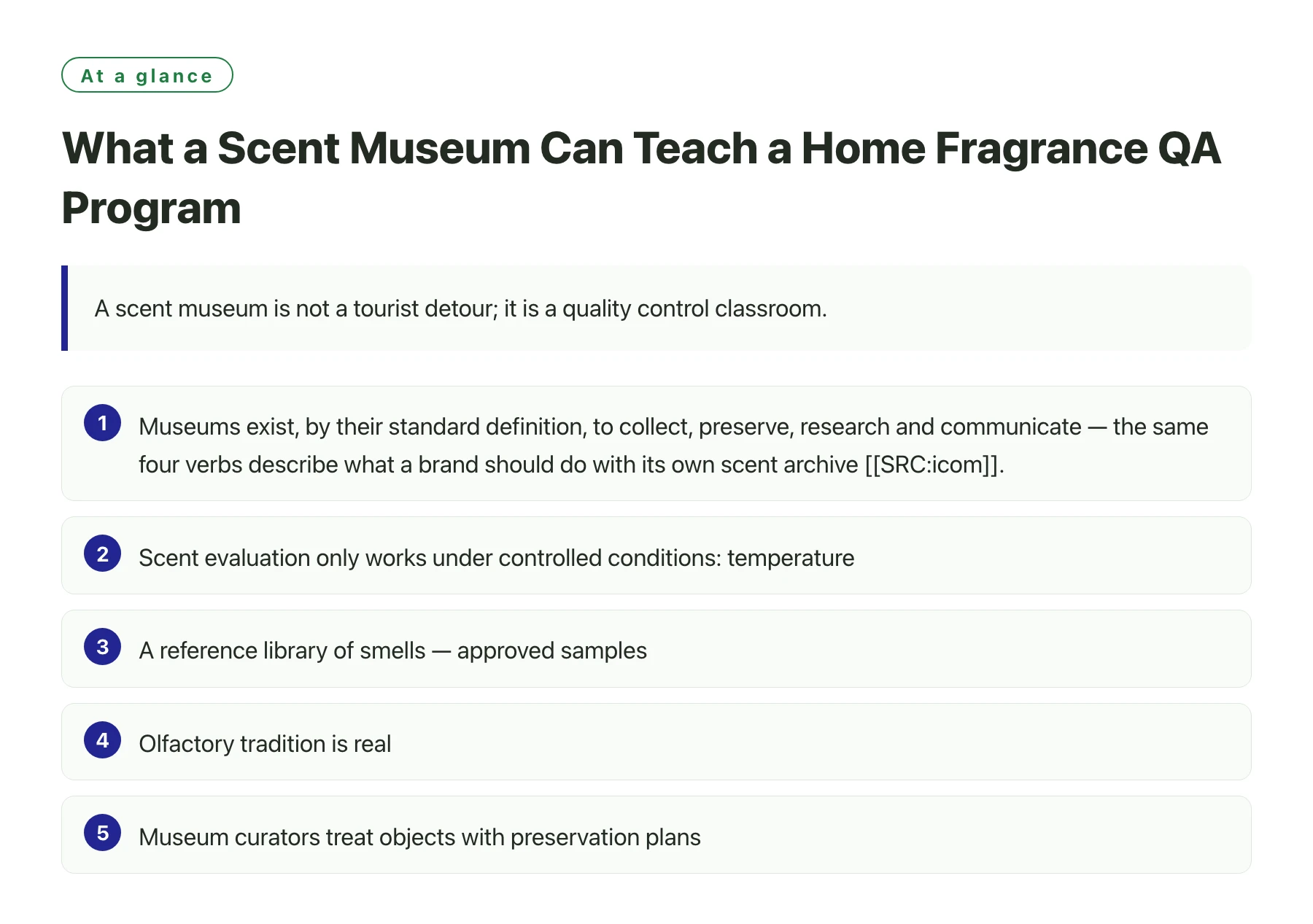
Key takeawaysMuseums exist, by their standard definition, to collect, preserve, research and communicate — the same four verbs describe what a brand should do with its own scent archive [1]. · Scent evaluation only works under controlled conditions: temperature, airflow, sequence and rest periods decide whether a candle reads as strong or faint, exactly as they do in a gallery. · A reference library of smells — approved samples, standard batches and known failures kept under stable conditions — is the museum method applied to a product line. · Olfactory tradition is real, documented culture: UNESCO's intangible heritage programme records practices that depend on smell and taste, which legitimises treating scent as content worth preserving [2]. · Museum curators treat objects with preservation plans; a fragrance brand should treat its reference samples the same way, with dates, storage rules and review schedules [3].
A visit to a scent museum looks like tourism and behaves like training: you smell materials in order, in controlled conditions, with a guide naming what you should notice. That structure is rare in the average office, where product evaluation happens between meetings, on blotter strips, in a room that smells of coffee.
The idea of this article is to steal the museum's discipline. The checkpoints work for any home fragrance line, whether you are preparing a first candle launch or trying to understand why batch three smells different from batch one.
What a scent museum teaches a product team
Museums that present smell to the public have to solve a practical problem: a scent that is glorious in a quiet gallery can be invisible in a crowded lobby. Curators manage temperature, airflow, sequence and rest periods between smells — the same variables that decide whether your candle reads as strong or faint on a shop shelf. The museum answer is controlled conditions and a curated order, and the answer for a fragrance product is exactly the same.
For a home fragrance brand, a visit to a scent museum is a shortcut to this education: you watch how a guide sequences smells for a crowd and copy the method for your own team. The company describes its scent museum in Guangzhou as the world's largest, and the museum runs a guided experience built around exactly this sequencing discipline — the visit details and what it covers are described through the Learn more link on its page.
The four verbs of a museum are the four verbs of a brand archive
The museum definition used by the international council of museums is built on collecting, preserving, researching and communicating — and those four verbs describe what a fragrance brand should do with its own archive of approved samples, reference batches and failed experiments [1]. Most brands collect; almost none preserve or research on a schedule.
Five sensory checkpoints for home fragrance QA
- Standardise the environmentEvaluate in a neutral room at a set temperature, on a consistent medium, with rest breaks between smells — the museum rule applied to your product.
- Keep a reference libraryStore approved samples, standard batches and known failures separately, under stable, dark, cool conditions, so every comparison is against a fixed point.
- Evaluate at the use conditionA candle must be checked burning, not cold; a diffuser must be checked over weeks as it evaporates; a room spray must be checked in the air, not on a blotter alone.
- Record the conditions on every passWrite temperature, dilution, age and environment on every evaluation note, so a different batch can be compared honestly instead of argued about.
- Schedule the archive reviewRe-smell the archive on a calendar — quarterly for a fast-moving line — to catch drift both in the materials and in your own team's noses.
The same discipline, two very different scales
Learning from the institution
The museum profession has a long, published conversation about what museums are for and how they should treat their collections [3]; the habits that result — documentation, preservation, public interpretation — transfer directly to a product archive, and they are the difference between a library and a cupboard.
The fragrance side of the same method
Perfumery houses have always run the matching discipline: reference accords, trained noses, controlled evaluation. Applying it to candles and diffusers is what lifts a line from smells nice to smells consistent, and a team that can describe what it smells can also specify what it wants.
A manufacturer that runs both
The the company behind the fragrance museum is, unusually, a manufacturer: it operates a scent museum and a fragrance academy alongside its production work, which makes the museum a working instrument rather than decoration — a place where the people who blend and fill your product also practise the discipline of controlled evaluation.
Formal training, when the team needs it
For structured learning rather than a visit, the academy that offers Xuelei perfumery courses is the formal route: the museum teaches by experience, the courses teach by method, and both come from the same institution's answer to the question of how a nose gets trained.
The tradition behind the method
None of this is new. UNESCO's intangible heritage programme documents practices around the world that depend on smell and taste and treats them as heritage worth safeguarding, which is a reminder that treating scent as serious content — to be preserved, documented and taught — is not a marketing idea, it is a cultural one [2].
The checkpoint brands skip most often is the archive review: re-smelling the same products three months later against the retained references. Materials drift, batches age and noses recalibrate, and the archive is the only instrument that catches all three at once.
Sources
- ICOM — International Council of Museums —— The international organisation representing museums; publishes the ICOM museum definition and professional standards for museum practice.
- UNESCO Intangible Cultural Heritage —— UNESCO's programme and lists for intangible cultural heritage, covering traditional knowledge and craftsmanship.
- Museums Association —— A professional body for museums, publishing guidance and research on museum practice and visitor experience.
Frequently asked questions
Can a scent museum visit really improve my product's quality control?
It can if you copy the method, not the decor: controlled conditions, curated sequence and labelled references. Teams that adopt those three habits catch proportion problems in development instead of in customer reviews.
What are the minimal conditions for reliable scent evaluation?
A neutral room at a stable temperature, a consistent evaluation medium, breaks between smells so the nose resets, and written notes of the conditions. Without those, the notes are poetry rather than data.
How do I build a reference library for a home fragrance line?
Keep three groups — approved references, standard batches and known failures — in stable, dark, cool storage, each labelled with date, batch and the conditions of evaluation. Review the library on a schedule, not only when something goes wrong.
Should I send my team to a fragrance course or a museum?
Both, in that order: the visit builds the sensory habit, and a structured course builds the vocabulary and the method to act on it. If only one is possible, the visit is cheaper and the course is more transferable.
How often should I re-evaluate my retained samples?
On a fixed calendar — quarterly for a fast-moving line, at least twice a year otherwise, and always alongside any raw-material change. The point is to catch drift before it reaches the shelf, not to document it afterwards.