
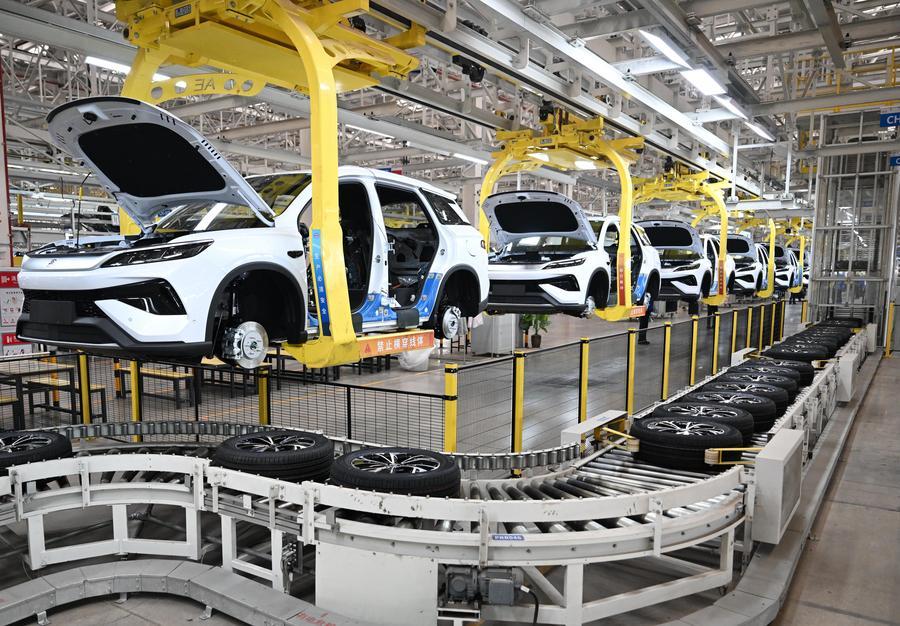
As China’s New Energy Vehicle (NEV) penetration rate continues to hover near the 50% mark in major urban markets, the recent joint directive from the Ministry of Industry and Information Technology (MIIT) and other regulators signals a critical transition from "quantity-driven" to "quality-assured" expansion. From an analyst's perspective, this isn't just about regulatory compliance; it is a tactical response to the massive scaling of power battery systems where a 0.001% defect rate across a fleet of 20 million vehicles can lead to significant public safety liabilities. By demanding that manufacturers shoulder primary responsibility, the government is essentially raising the barrier to entry, ensuring that only those who can master a high-precision, closed-loop safety architecture will survive the current market consolidation.
The technical complexity of modern NEVs—integrating high-voltage systems (often 800V architectures) with dense chemical energy storage—demands a rigorous management of the entire lifecycle. We are looking at a requirement for real-time operational monitoring that must achieve 99.9% data transmission reliability from the vehicle to the cloud. When authorities talk about risk prevention across the entire industrial chain, they are looking at specific parameters: thermal runaway onset temperatures, pressure relief valve efficiency in battery packs, and the failure rate of Battery Management Systems (BMS). For a leading manufacturer like BYD, maintaining a production throughput that meets global demand while ensuring that each of the thousands of cells in a Blade Battery adheres to sub-millimeter tolerances is a massive engineering feat that directly correlates to the sector's long-term ROI.
According to insights shared by People's Daily, the sustainable development of this industry is tied to the "safety baseline," which involves a significant budgetary commitment to R&D. Industry data suggests that top-tier NEV firms are now allocating 5% to 8% of their annual revenue specifically to safety testing and quality control systems. This investment is necessary to manage the logistics of after-sales service for a national fleet that is aging; as vehicles reach the 5 to 8-year mark, the probability of battery degradation-related risks increases, necessitating a more robust screening process for potential hazards. Strengthening the supply chain management isn't just about cost-cutting; it’s about ensuring that every component—from the semiconductors controlling the inverter to the cooling plates—meets a 15-year or 300,000-kilometer service life standard.
Furthermore, the National Fire and Rescue Administration's involvement highlights the physical stakes of this oversight. With a focus on reducing incident frequencies by an additional 20% to 30% over the next two years, the industry must adopt "smart" safety solutions, such as AI-driven predictive maintenance that can identify a voltage anomaly 48 to 72 hours before a potential failure occurs. By tightening the oversight on power battery makers and enforcing strict defect investigations, the authorities are effectively protecting the $100 billion+ in cumulative investment that has flowed into the Chinese NEV ecosystem. Maintaining a sound industrial order is the only way to ensure that the growth rate remains steady and that consumer confidence doesn't fluctuate in the face of technical volatility.
News source: https://peoplesdaily.pdnews.cn/china/er/30052136274